Saturday, 17 August 2019

Tracking North to a historic secret World War 2 US air force base

Our second day of flying had us leaving from Louth and following the Darling River to Bourke.  Tracking along the Darling is difficult as it’s not one river in many places but a series of side streams and tributaries.

After a pleasant 32 min flight we dropped into Bourke just long enough to fuel the aircraft, have a pee and we were off again.

VH-BAC is powered by a Lycoming IO-360 which is very common and most pilots plan a fuel consumption of 35 litres/hr for that engine type. We were a bit horrified to learn when we collected her that we should plan for a consumption of 38 litres/hr.  That was going to make some of our longer legs a bit tight.  We were pleased to find after refuelling for the first time that our actual consumption was 30 litres/hr which was what I expected.  Phew!

The track from Bourke to Charleville was over mostly featureless scrubby cattle country and we entertained ourselves spotting the stations marked on the charts and their airstrips.  Many are marked on the charts as ALA’s (Aircraft Landing Area) but can be difficult to spot. The highlight of this leg was the testing of the Aussie Aviation Vacuum Cleaner.

We were flying in the early afternoon and the ground was heating up so it was a bit lumpy and bumpy. Simon used to fly gliders so gave me a lesson on how to read the clouds and where to expect updrafts and downdrafts so that was useful and we surfed the updrafts to gain 10 - 15kts of ground speed only to loose it when we fought the next downdraft.

On our arrival we joined a tour of the Charleville Airfield which was really interesting.  The Airfield occupies a large area as it was built during the Second World War. In its heyday there were 3,500 US Airmen stationed at the base, 101 buildings and 160 aircraft which included B-17 and P-38 and many other types. Charleville was selected at the time as it was out of range from a naval aggressor or enemy bombers.  All that remains now are the large runways and taxiways and a hangar but on the tour we were taken around many sites where the foundations of buildings and large aircraft tie-downs were still evident if you knew where to look.

Flat & featureless from horizon to horizon but there’s always something to look at. Love it.
We met the rest of our team at Charleville. A very nice pressurised Cessna 210, Falco, our Cessna 172 and Cessna 182
Charleville World War 2 tour
Rocks Motel, Charleville. Lovely.

Leg Summary:
Route: Louth (YLOH) - Bourke (YBKE)
Distance: 52nm (96km)
Time: 0.5hrs
Alt: 2,500ft

Route: Bourke (YBKE) - Charleville (YBCV)
Distance: 217nm (385km)
Time: 2.2hrs
Alt: 4,500 & 6,500ft

Outback Aviation Vacuum Cleaner

Flies are a real problem at some of the Outback locations we’re visiting.  There’s hundreds of them and they’re persistent.  That’s why Aussie’s wear hats with corks dangling from the brim.

Having flies in the aircraft is a pain.  You can’t keep them out and they enjoy the ride while crawling all over you when you’re trying to concentrate - but we’ve found a solution that works a treat.

We purchased a short length of garden hose and when the aircraft window is opened and the end of the hose is allowed to enter the aircraft slipstream it creates a neat vacuum cleaner that sucks the flies up.

We had so much fun and so many laughs doing this, I think we’ll try and round up some flies and load them in the aircraft at the next stop.


Thursday, 15 August 2019

And we’re off

We started on our first leg of our trip today in beaut flying conditions.

Simon flew this first leg and we departed at 11:00am pretty much at our planned time after weighing all our bags, packing the aircraft and going over our route and weather together.  Our objective was to meet Shelley and Pete at Louth at 2:00pm.

Leaving Bathurst we climbed to 6,500ft to clear some high ground to on track to the northwest and up there the weather was fine and clear without a cloud from horizon to horizon.  Not long after leaving Bathurst we heard Shelley in Cessna 182, VH-BMJ on the Melbourne Centre area frequency and chatted to her briefly on a chat channel.

Our route took us over farm country and a patchwork of grassy and plowed fields.  From about halfway farmland gave way to scrubby cattle country that, apart from the scrub, is flat and featureless.  The three hours enroute passed quickly before we had to start looking for the Louth airfield and planning our approach.  Our timing was spot on with Shelley and Pete beating us by 10mins.

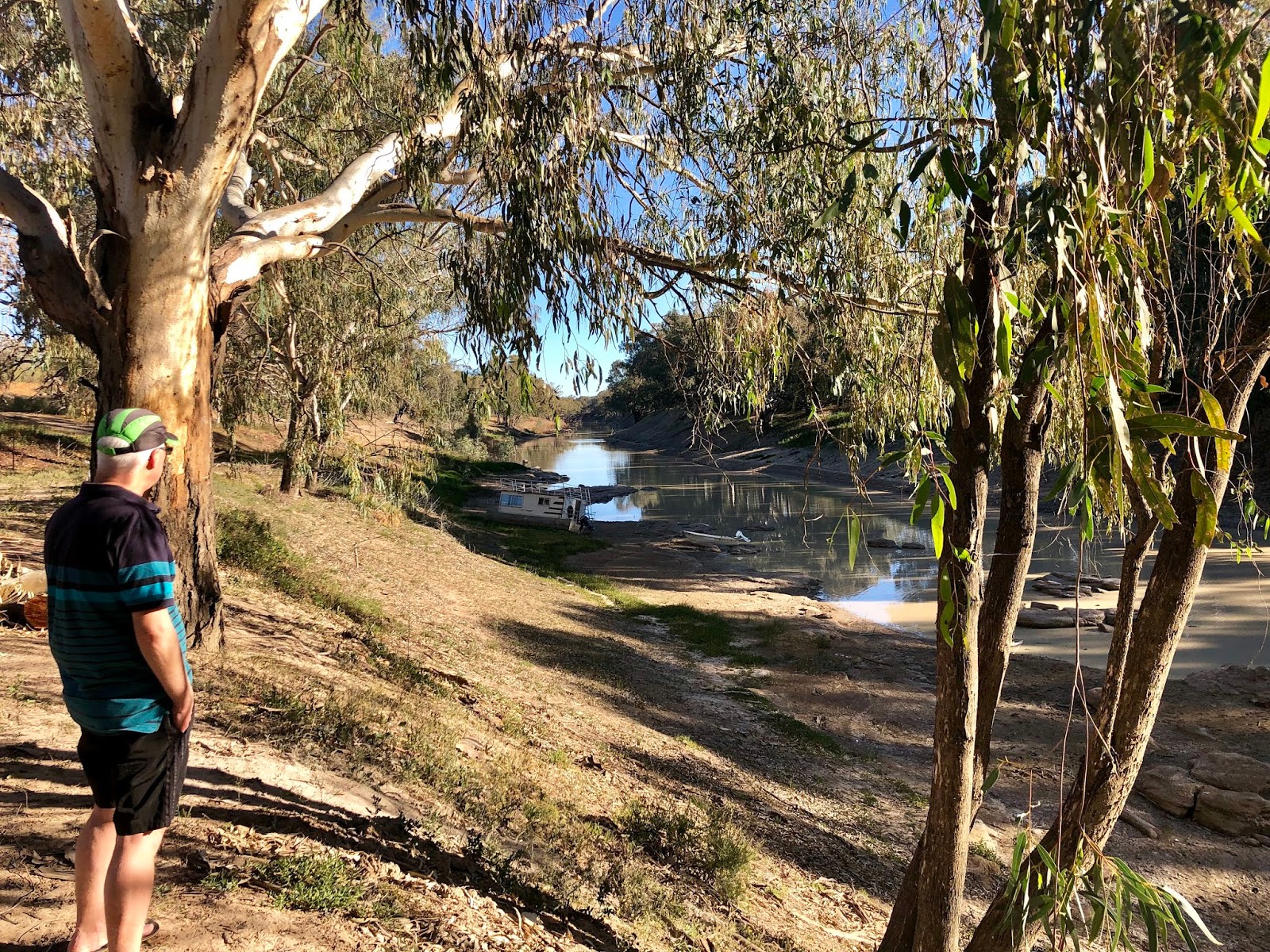
Louth is your typical outback town.  With a population of 40, it’s a cluster of buildings on the banks of the Darling River between a pub and a racecourse. Just last weekend the population swelled to 4,000 as people came from miles around for the annual Louth races.

The Darling is just a trickle of water these days and is very low. In its day it was a major transport artery as barges and paddle steamers moved people, stock and wool up and down the river.

Leg Summary:
Route: Bathurst (YBTH) to Louth (YLOH)
Distance: 288nm (533km)
Time: 3.3hrs
Alt: 6,500 - 4,500ft

Lock up your daughters - the boys are coming

Darling River

Darling River

Flight Tracking

Several people have asked me how they can track our flight.  I worry about these people and didn’t think there were many like me who are obsessed with an aircraft inching along a track minute by minute.

My aircraft ZK-VRV, aka “Thunderbird 6” has Spidertracks installed.  Spidertracks uses the Inmarsat satellite constellation to send position reports at 2 minute intervals which can plot an aircraft position anywhere on the Earth.

VH-BAC doesn’t have Spidertracks installed but instead has an ADSB-Out Transponder which is used by Air Traffic Control to identify and seperate aircraft.  All private aircraft operators are being encouraged to install ADSB which is not cheap and provides few benefits to a private aircraft operator. It’s a contentious subject ... don’t start me!

Anyway - VH-BAC has an ADSB transponder installed and can be tracked using FlightRadar24.  FlightRadar24 is an amazing free web site that allows you to track aircraft anywhere in the world - including me.

If you click the following link, FlightRadar24 should be launched and show the latest track recorded by VH-BAC so you can see where we are and where we’ve been:  FlightRadar24 - VH-BAC

For those of my mates that use AvPlan, you should be able to see us in the normal way.

Introducing VH-BAC

It’s cold in Bathurst!  Our day began with a walk at 7:45 am to find some breakfast in -3 deg Celsius.  Although cold it was a calm, crisp morning and not unpleasant.

Although both licensed to fly in Australia, Simon and I each have to undertake a flight review to ensure our licenses are current. Our flight reviews were scheduled with Ward Air.  Arriving at Ward Air we were introduced to Matt Norgrave and the Ward Air team and made to feel very welcome.  We then walked down to the Bathurst Aero Club to be introduced to VH-BAC - the aircraft we’ve hired for our trip.

VH-BAC is a 1999 Cessna 172S which the Bathurst Aero Club has owned since new.  Powered by a 180Hp,  IO-360 she’s well equipped, in good condition and is well setup for cruising with GPS, VOR, ADF and an autopilot. Although not particularly fast, VH-BAC cruises at an honest 110kts (203km/hr) and has an endurance of 4.8hrs (with reserves) which is more than enough for some of the long legs we’ll do ... and she’s got comfy sheepskin seats 😍.

Our flight reviews involved demonstrating steep turns, stalls in clean and landing configurations, a simulated forced landing and various circuits and other emergency procedures that took about 1.25hrs each.  By the time we each flew it was a lovely clear, calm day. 

Flying with an unknown instructor is always a bit of a test.  They don’t know you and you don’t know them.  However, thorough and standardised aviation disciplines quickly erode any apprehensiveness (for both parties) and it can actually be quite good fun particularly in an area you’re unfamiliar with.  Both Simon and I both enjoyed our flight reviews and the relaxed but thorough way Matt conducted them.

After our flights we reviewed our planned route with Matt and he checked we were using the correct resources for sourcing weather, NOTAMS, etc. Both Simon and I use AvPlan EFB and do all our planning with electronic resources.  I think Matt was quite impressed at how quickly and effectively we can prepare aflight plan and vary a plan enroute using AvPlan.  All of the instructors at Ward Air were genuinely impressed with the route we plan to fly over the next 3 weeks and they were all very helpful with “tips and tricks”.  One of those was how to get flies out of the aircraft as they can be a real nuisance in flight. I can’t wait to show you how we plan to do that!

VH-BAC is a lovely aircraft, flies smoothly, straight and true and both Simon and I are now “legal” to fly.  Tomorrow the adventure begins ...

VH-BAC, An Aircraft Eagerly Awaiting an Adventure


Oh Dear - So Many Knobs & Buttons

Monday, 12 August 2019

Australia 2019 Route


Click to display full size

Simon and I will be one of five aircraft following a route planned by good flying buddy Shelley Ross.  Ourselves, Shelley and her husband Pete in a Cessna 182 and three other aircraft will be joining and leaving a happy band of aviators as we all loosely follow the same route to the Kimbereley region and return - a bit like a Gypsies!

We collect the Cessna 172 aircraft we're hiring (VH-BAC), from Bathurst Aero Club on 14 August and have set a day aside for our check rides to satisfy the Australian licensing requirements and aircraft insurance, planning, aircraft preparation and shopping for any supplies we decide we need.

When we set off from Bathurst the following day we travel NW to our first overnight stay at Louth where we'll meet up with Shelley & Pete at Shindy's Inn, our first outback pub.  Shelley & Pete are great company so I'm looking forward to catching up with them and introducing them to Simon.

The following day we fly about 30mins NE to Bourke for fuel and then carry on to Charleville where we'll meet up with Steve, Lynne, Don and Suzie in Steve's Cessna 210 and Neil and Suzie in their Falco.  We'll be touring off and on with them all over the next few weeks.

As we cross into the northern half of the Australian continent heading for Longreach, the weather should begin to get warmer and more settled (fingers crossed).  Longreach is a great place that I've visited many times before.  We have two nights there which gives us time to visit the Qantas Founders Museum and Australian Stockman's Hall of Fame.  Although I've been to both these attractions before you always find something new to look at.

Leaving Longreach we've got a total of about 2.5 hours of flying as we track NW to Mt Isa for fuel and then turn north to Adels Grove.  Our track to Mt Isa passes the Combo Waterhole where it's reputed that Banjo Patterson wrote Waltzing Matilda.  Combo Waterhole looks like any other outback waterhole but is worth flying over to check for any jolly swagmen or any jumbuck drinking from the billabong!

Adels Grove is a favourite outback destination of mine as the bordering Lawn Hill National Park is a lovely oasis in a dry, harsh landscape with iconic Australian steep gorges of red rock.  Sadly, a fire destroyed Adel Grove's main reception, restaurant, bar and kitchen at the beginning of July.  However, we understand they remain open for business with a "bush bar and kitchen" setup.  That will be good to see.

After a night at Adels Grove, our track takes us to the northern most points on our route as we call into Borroloola for fuel  and carry onto Kununurra.  This will be one of our longest days of flying as we clock up 638nm in about 5.5 hours.

At Kununurra we pick up a rental and drive south to stay for two nights on the banks of Lake Argyle at the Lake Argyle Resort.  The resort looks very nice and I'm looking forward to the sunset cruise we have booked on the lake.

From Kununurra we head into my favourite part of Australia - the Kimberley Region.  This is about as beautiful and remote as it gets and the best way to take it all in is from the air.  Our route map shows that we'll fly from Kununurra to Derby - but that ain't the truth.  I intend to fly down the long Prince Regent Gorge out to the lovely islands and meandering waterways that comprise the Kimberley Coast before heading south to Derby.

At Derby we'll park our aircraft up for a night and catch a float-plane out to the Horizontal Falls.  Staying on floating accommodation anchored close by will allow us to experience the falls when they're running at their peak.  David Attenborough has described the Horizontal Falls as "one of the greatest wonders of the natural world".  They are formed from a 25 metre gap in the ranges between two large coastal inlets. The large tidal variation on the Kimberley Coast creates the falls as seawater builds up faster on one side of the gap than the other, creating a waterfall up to 5m high on a spring tide. With each change of the tide, the direction of the falls reverses, creating vast tidal whirlpools.  I've flown over the falls several times and they're impressive.  It will be great fun roaring through them in a powerful boat.

Returning to Derby we fly onto the Mornington Wilderness Camp for some "eco-glamping" within a wildlife sanctuary.  We have two nights at the camp and it will be great to stretch our legs on some long walks and dine under the stars far, far away from city lights where the night sky is spectacular.

After a few days in remote locations it's off to the hustle and bustle of Broome (I'm joking) where it will be good to sit on the beach and watch the sun set (surprising quickly) with a drink in my hand.  There's lots of interesting history in Broome associated with the pearl industry that I'm looking forward to exploring with Simon.

Having learnt a bit about the history of pearling in Broome, we then head north on a 1 hour flight to Cygnet Bay Pearl Farm on the Dampier Peninsular to stay on a modern working pearl farm.  I've stayed on the Dampier Peninsular before (at Cape Leveque) and this Kimberley coastal region is beautiful.  White, sandy beaches and a warm semi-tropical climate makes a stay here idyllic.  We may never come home.

After a week in the Kimberley, sadly, we'll have to leave it behind as we point our aircraft to the SE and begin the long trek back to Bathurst through the middle of the continent.

Our route will take us from Halls Creek over the Wolfe Creek Crater (big big hole in the ground) to Ayers Rock.  This will be a big day of flying over 500nm as we call into Ayers Rock for fuel and carry on to Curtin Springs.  The overnight aircraft parking charges and accommodation at Ayers Rock are a bit pricey so we've decided not to overnight at Ayers Rock.  However, we will fly the tourist route around Uluru before parking up for the night at the Curtin Springs roadhouse.

Ayers Rock Scenic Flight Route
Leaving Curtin Springs we continue SE to William Creek for fuel.  This remote outback settlement (population 10) is where my son, Andrew got his first commercial flying job flying tourists over Lake Eyre.  I've stayed there several times and love its remoteness.

The Arkaroola Wilderness Sanctuary is our next stop. Arkaroola is a geological sanctuary in the Northern Flinders Ranges and boasts some of the oldest rocks in the world.  It's dry, dusty but spectacular.  The Ridgetop Tour is an amazing half-day 4WD tour that is not to be missed and always results in new found respect for the Toyota Landcruiser.

Our final stop on this trip is at Broken Hill where I expect we'll take a look at the very good Royal Flying Doctor museum and their art galleries before heading back to Bathurst the following day.

The planned route is 4,577m (8,476km) although might be a little higher with the obligatory scenic diversions particularly in the Kimberley region.  At 115kts (213km/h) our flight time is expected to be around 40 - 45hrs.

I can't wait - bring it on!


It’s time for another adventure

3 or 4 months ago my good friend Shelley Ross told me of a route across the Australian continent she was planning and invited me to tag along.  As the route involved a week in the Kimberley region in the North West it was hard to resist.

For a long time I’ve been telling my good flying buddy Simon Ford that he needed to do a flying trip in Australia. It’s so different to what we’re used to here in New Zealand.  With a bit of “gentle but consistent pressure” on Simon (and our wives, Sharon and Lynette for a leave pass) my objective was realised.  Simon agreed to join me and we both received weary domestic approval to proceed - planning began immediately!

What Shelley doesn’t know about touring in the outback doesn’t matter and the route she had planned was superb.  However, there was a few favourite places of mine that I’ve been telling Simon for years that I wanted to show him that weren’t included.  Shelley has invited other pilots to join our small group so what’s evolved is a bit of a gypsy caravan tour with pilots and aircraft coming and going as we traverse the great dusty Australian continent.  It will be great fun with an eclectic mix of people, planes and destinations.  I can’t wait - come along for the ride ...

Simon & Peter